Assessment proxy
A Test Score Is a Decision Aid, Not a Capability Object
An assessment can support a carefully bounded decision when its evidence matches the claim. A score becomes dangerous when it is stored as the skill itself.
What the wrapper says
Assessment produces a result for a stated decision, while psychometrics explains the conditional evidence and error behind interpreting that result.
The all-clear
Assessments and psychometric methods make consequential decisions more consistent, reviewable, and explainable.
What is durable
The capability evidenced by performance across relevant tasks and conditions, with uncertainty made explicit.
The dashboard says Certified.
There is a green tile on your dashboard.
There is a pass rate.
There is an export called capability_readout_FINAL2.xlsx with a column named proficiency_level.
Somebody asks whether everyone in that category can be scheduled for independent work.
Nobody can answer.
The programme began with a short quiz.
The decision arrived later.
And the score is now being asked to perform a small act of workforce ontology.
This is a very common corporate magic trick.
An assessment result is useful.
It can tell you something real about a person’s performance under stated conditions.
It can support placement, feedback, certification, or a carefully bounded operational decision.
But a score is not a capability object.
A capability is the durable thing. A score is evidence produced by one encounter with an instrument.
That gets uncomfortable when the score leaves the assessment system, enters a skills platform, and starts recommending training, staffing and promotions.
The field travels neatly.
The form, the task sample, the scorer, the accommodation, the outage log and the decision it was designed to support generally do not.
And then the machine sees 73 and behaves as though it has met a person.
The number starts answering the wrong question
The first question is not what you should test.
It is what decision this result will support.
Write your claim in one sentence.
Using this result, we will decide whether the learner can perform something, under stated conditions.
Name the performance, the conditions, the population, the decision maker, the consequence, and whether it can be reversed.
A fifteen-minute diagnostic at course entry can identify missing prerequisites.
It should not quietly become a grade.
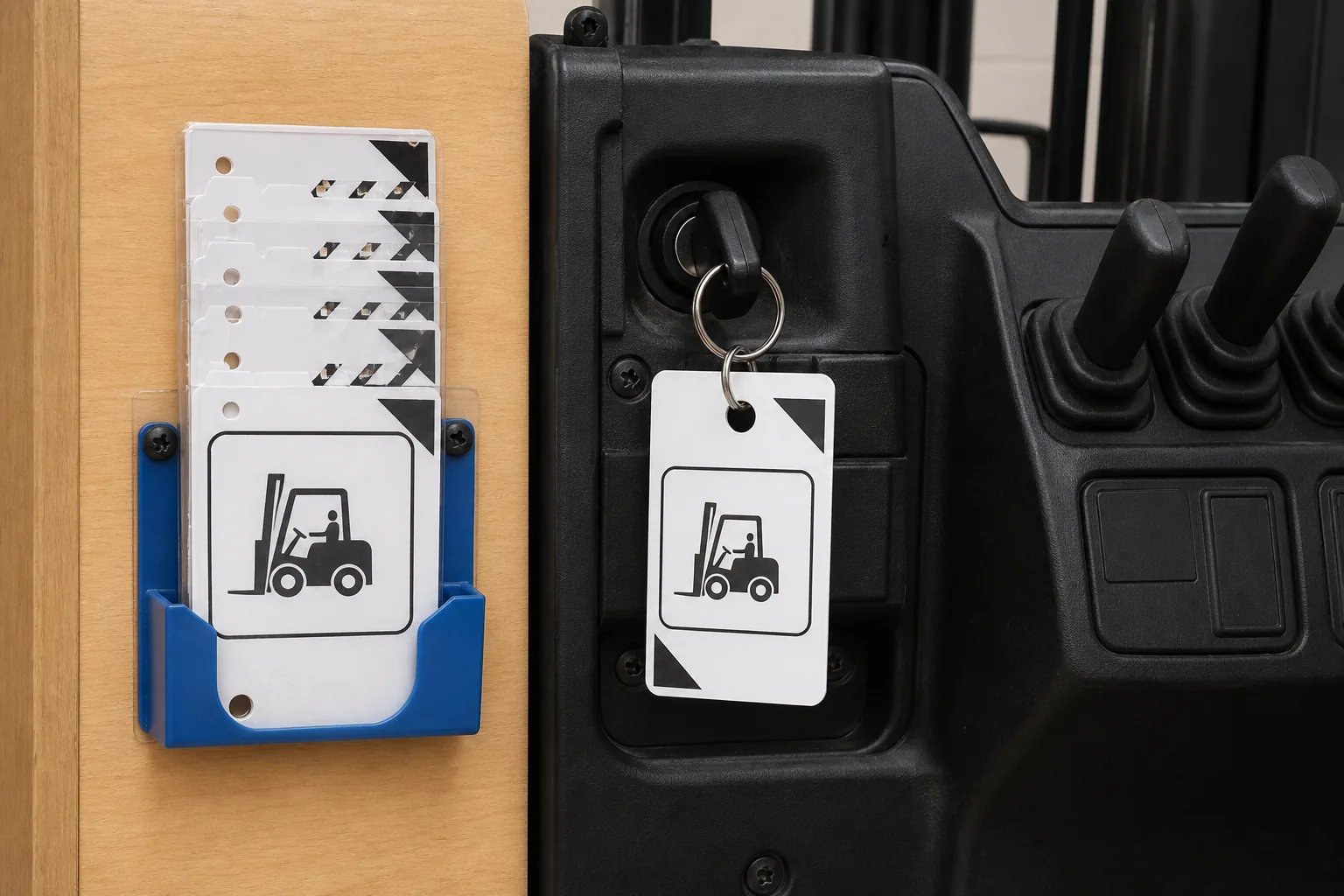
A result used to adjust tomorrow’s practice group is not the same object as a result used to permit independent operation of a forklift.
Both may be numbers.
The consequences are doing rather different work.
Here is a concrete version.
A score of at least 18 of 24 supports a decision that a trainee can complete a routine inspection with no critical omission, under observed conditions.
Useful.
Specific.
Reviewable.
It does not say the trainee has Inspection Level 3 in all circumstances until the end of time.
It does not say the trainee can manage a novel failure, work from a different procedure, or train the next cohort.
The score supports the claim it actually makes.
It becomes dangerous when the conditions are stripped off and 18/24 becomes competent becomes a durable record in your HR system.
That is how an instrument result acquires a passport, a career history, and undeserved confidence.
The blueprint is the part nobody puts on the dashboard
Before items exist, an assessment needs a blueprint.
Content or task areas down one side.
Performance demands across the top: recall, interpretation, procedure, explanation, judgment, production.
That unglamorous table decides what your score can plausibly mean.
A 40-point assessment might give 16 points to routine procedures, 12 to diagnosis, 8 to safety decisions and 4 to documentation.
That distribution is a judgment about the decision claim.
It is not an accidental residue of whichever material had the nicest slides.
The same problem appears at another scale.
A 60-item examination observes at most 60 item-level responses.
A two-station clinical assessment observes two task contexts.
Neither can exhaust the broad, changing capability you care about.
Psychometrics has a name for the limit: construct underrepresentation.
A narrow sample produces a stable score while omitting central elements of the work.
Its opposite is construct-irrelevant variance.
A numeracy problem written in 250 words of dense prose is measuring reading demand as well as numeracy.
No reliability coefficient can decide whether that extra demand is acceptable.
That is a judgment.
Which is why an outcome labelled “analyse” cannot be evidenced by an item asking candidates to recognise a definition.
The topic matches.
The demand does not.
Your learning platform will accept both results in the same field.
It has no opinion about the difference.
That is what makes it so easy to build a very polished record of the wrong thing.
The administration is part of the result
Two of your scores with the same number are not necessarily comparable.
One may come from an earlier item version and rubric.
Another from a revised form after a content review.
One may have been delivered under controlled access.
Another as an open-resource case.
One may include an accommodation that preserves the intended construct. Another may contain a technology barrier the design never considered.
Those are not footnotes.
They are components of your evidence.
For a pilot, the programme records completion time, clarification requests, navigation errors, resource use, interruptions and technical failures.
Three candidates stopping at the same instruction is evidence about the instruction.
It is not three people who should be reminded to read more carefully.
For a live examination, a seven-minute outage belongs in the incident log, with the affected candidate, the action taken, and the equivalence of treatment.
The same record keeps the announced form, the instructions, the timing, the resources, the identity procedure, the scorer material and the contingency plan.
All of which feels excessive right up until a one-point margin triggers a promotion, an access grant or a remediation decision.
Then everybody would quite like to know whether the platform went down.
Scoring needs the same treatment.
Constructed work needs a locked rubric, anchor responses for scorer calibration, and scores by dimension when the report is going to guide remediation.
A four-point gap on a 20-point task can reveal that two qualified scorers mean different things by “sufficient evidence,” even when both candidates pass.
The total score is not always the useful result.
A pass can conceal the thing that matters
Your performance rubrics should define observable dimensions, evidence, levels, and non-compensable critical errors, before anyone starts.
A four-level rubric can distinguish novice, developing, competent and exemplary work, if its levels describe visible features.
“Good” and “excellent” are not descriptors.
They are weather reports.
Some scoring rules add points.
Others are conjunctive: every designated critical criterion must be met.
That distinction is operational, not academic.
A person can accumulate a high total while missing a safety-critical requirement.
And if you report only the total, you have created a convenient way for a downstream system to conclude the opposite of what the assessment found.
The same caution applies to integrity signals.
A proctoring flag, a similarity score, an unusual webcam event: that is information to investigate, not proof.
Remote-proctoring flags produce false positives.
The evidence chain needs the rule, the event, the available data, the reviewer, the alternative explanation and the action.
You do not become more rigorous by calling a signal a finding.
You become less able to explain yourself later.
The instrument is doing real work here
None of this argues for abandoning assessment and returning to a staffing meeting where the deciding evidence is whoever speaks most confidently about the old system.
Assessments make decisions more consistent.
They create reviewable learning paths.
They identify prerequisites, provide feedback, establish credentialing thresholds, and make performance expectations explicit.
Psychometrics gives large programmes real tools: field testing, scorer monitoring, form assembly, adaptive delivery, fairness analysis, qualified score reporting.
Take field testing.
On a form piloted with 400 examinees, an item answered correctly by 392 of them has very little score separation in that population.
It may still be a valuable entry-level check.
Eight omissions out of 400 is a 2 percent omission rate.
If comparable items show none, that is a reason to inspect access or timing.
Nobody deletes an item because a statistic looked odd in your spreadsheet.
The programme inspects the content, the key, the translation, the response-time pattern and the intended process.
Then it retains, revises, recalibrates or removes.
All of that is good infrastructure.
The point is only that its output stays conditional evidence, rather than an eternal property to be glued onto a worker profile.
Passing is a policy decision supported by evidence
Passing thresholds are unusually prone to being mistaken for natural features of the universe, like gravity or the chief executive’s travel schedule.
They are not.
A modified Angoff study asks qualified judges to work from a description of a borderline candidate.
On a 100-item form, a judge’s probabilities might sum to 67.4 expected points.
The panel discusses, repeats the judgments if that was planned, and then sees impact data.
For a proposed cut of 68, what proportion of the reference group lands at each level?
The numbers discipline the conversation.
They do not produce a uniquely correct policy.
Psychometric staff then examine the standard error of the panel judgment, the consistency across rounds, the score precision near the cut, and the effect of moving one whole point.
Judges recommend.
You, or whoever owns the consequences, adopt, modify or reject.
Keeping those two acts separate is what preserves accountability.
So a score of 69 against a 70-point cut is a difficult decision case.
It is not a sign that arithmetic has broken.
And a confidence band around a score does not prove that a candidate’s latent proficiency literally lives inside it.
It reports the implications of a chosen error model.
The most useful score report is the one that changes what the recipient does.
A result three points below a boundary, with a standard error of measurement of three points, can warrant corroborating evidence or a retest.
A result well clear of it can support a firmer action.
Neither result is a person’s skill.
Both can assist a decision.
AI makes the lost context expensive
For years, assessment systems kept their own technical files, score reports, form histories, panel records and incident summaries.
The score was a result inside a programme.
Then workforce systems began ingesting learning histories.
Then talent platforms began matching people to opportunities.
Then AI began recommending learning, inferring gaps and ranking candidates.
The number escaped.
AI prefers numeric fields, because numeric fields look settled.
A score without its evidence model is particularly persuasive: sortable, rankable, and wonderfully free of annoying questions about task sampling, rater severity, different forms or conditions.
Consider reliability.
An alpha of .88 from a large field test estimates average internal consistency for that administration and that group.
It can be lower for a smaller or more homogeneous group, a translated form, or candidates with less time.
An average standard error of four points can conceal errors of two points at the top of the scale and seven points at the bottom.
That is not a defect in statistics.
That is the information that stops a number impersonating certainty.
Automated scoring and fairness monitoring work the same way.
Where a form flags items for differential functioning, each flag needs content review, replication and scrutiny of the matching model.
The item is retained with rationale, revised and retested, restricted, or removed.
It is not declared fair because an algorithm found it convenient.
When your AI system receives only a pass mark or a proficiency label, all of that work disappears.
The system may recommend a promotion, block an access grant, or prescribe training long after the assessment can support that interpretation.
Very efficient.
Also wrong.
Store the evidence model beside the number
The practical fix is neither mystical nor expensive in concept.
Keep your capability record separate from your assessment-result record.
The capability record describes the relevant performance and its conditions.
The result record stores the instrument, the form and version, the date, the permitted resources, the accommodation, the scorer and scoring rule, the decision claim, the critical criteria, the incident record, the uncertainty where you have it, and the review status.
Store the reported category as a category.
Store the score as a score.
Do not relabel either as a durable skill level because your database needed a noun.
Then give the score a review trigger.
A result near a cut line.
A changed form.
A material incident.
A scorer disagreement.
A different population.
A new high-stakes use.
Any of those should send somebody back to the claim-and-evidence register: claim, decision, evidence source, limitation, owner.
For a low-stakes exit ticket that fits on one page.
For a credentialing programme it becomes a technical file.
The formality changes with the stakes.
The distinction does not.
The durable object is capability evidenced across relevant tasks and conditions, with the uncertainty made explicit.
The wrapper is a score, a pass mark or a proficiency label, produced by one instrument, one form, one administration and one scoring rule.
One of those is durable.
The other one expires the moment you strip its conditions off.
And when capability_readout_FINAL2.xlsx says otherwise, it is not because the spreadsheet has discovered a human truth.
It is because somebody asked a decision aid to become a person.
What the record establishes
- Write a decision claim before choosing a test format.
- Build a blueprint before drafting items or selecting tasks.
- Retain form, administration, scoring, and incident metadata with every result.
- Report critical criteria separately from a total score.
- State score limitations, uncertainty, and review triggers near decision boundaries.
- Keep standard-setting recommendations separate from the authority's policy decision.
Asked in the review
- What should be written before anyone chooses a test?
- An assessment begins with a decision claim: what decision the result supports, what performance is being inferred, under which conditions, for which population, and with what consequence. A 15-minute entry diagnostic can identify missing prerequisites, while permission to operate independently requires a different claim and stronger evidence. Writing the claim first prevents a convenient test format from silently acquiring a higher-stakes purpose.
- Why is a test score not the same thing as a skill?
- A test score is the result of a particular instrument, form, administration, and scoring rule. A skill is capability demonstrated across relevant tasks and conditions. A score of 19 out of 24 can support a stated operational threshold of 18 under standard conditions; it does not establish universal competence. Storing the score as the skill removes the conditions that make its interpretation defensible.
- What does an assessment blueprint actually do?
- An assessment blueprint maps content or task areas to the performance demands the assessment must sample before items are drafted. A 40-point assessment can allocate 16 points to routine procedures, 12 to diagnosis, 8 to safety decisions, and 4 to documentation because those weights match the decision claim. The blueprint makes omissions, weighting choices, and narrow coverage visible for review.
- What records have to stay attached to a score?
- A usable assessment record retains the form and version, announced instructions, time window, permitted resources, accommodation, scoring rule, scorer information, incidents, and material-access exceptions. For a 90-minute examination, a seven-minute outage belongs in the incident log with the affected candidate and the action taken. Without this metadata, a later reader cannot tell whether two apparently identical scores were produced under comparable conditions.
- Why should a critical safety criterion be reported separately from the total?
- A total score can conceal a non-compensable error. A performance rubric therefore identifies observable dimensions, evidence, levels, and critical errors before delivery, then states whether the decision rule is additive or conjunctive. A conjunctive rule requires every designated critical criterion to be met. Reporting that criterion separately prevents a high total from being misread as evidence that a safety-relevant requirement was satisfied.
- What should happen when a mark lands just above or below the pass line?
- A borderline result triggers review of scoring, administration incidents, and the published retake or appeal policy; it does not automatically invalidate the result. A one-point margin around an 18-of-24 threshold makes decisive separation less credible than a wide margin. A score report can state the observed score, category, conditions, and uncertainty so the decision is not mistaken for a permanent capability label.
- Who decides what score counts as passing?
- Qualified judges can make a structured standard-setting recommendation, but the authority responsible for consequences owns the policy decision. In a modified Angoff study, judges estimate how a defined borderline candidate would perform, examine impact data, discuss judgments, and document the recommendation. Psychometric staff examine precision near the proposed cut; the decision maker may adopt, modify, or reject the recommendation.
- Can a reliable score still support the wrong decision?
- Yes. Reliability describes error under a particular design, population, and use; it does not prove that the assessment sampled the right capability or supports every later decision. An alpha of .88 from a 1,000-person field test is an average estimate for that administration and group. It can be lower in a different population, and it can omit task, rater, occasion, or construct-coverage problems.
- Why does a pass mark need evidence instead of a number that feels sensible?
- A pass mark classifies people and therefore needs a documented performance-level description, decision rule, qualified judges or authority, and evidence about precision near the boundary. On a 100-item form, a modified Angoff judge may estimate 67.4 expected points for a borderline candidate, while impact data show the classifications a proposed cut of 68 creates. Neither number supplies an ethically unique threshold.
- What should an AI system receive with an assessment result?
- An AI system receives the result together with the decision claim, target capability, form and version, administration conditions, scoring rule, critical criteria, uncertainty, and review status. A numeric field alone encourages a system to treat 73 as a stable person attribute. A report of 73 points with an SEM of 3 points and an approximately 67.1–78.9 95 percent band instead describes conditional evidence for a defined decision.
- Does a remote-proctoring flag prove that someone cheated?
- No. A proctoring flag, similarity score, or unusual webcam event is a screening signal, not a misconduct finding. A review records the applicable rule, observed event, available evidence, reviewer, alternative explanation, and action. Remote-proctoring services can produce false positives, so aggregate incident rates identify controls needing inspection but cannot establish an individual violation without case-level review and due process.
- When does a score stop being transferable to a new use?
- Evidence accumulates for an interpretation in a particular setting and does not automatically transfer to a new use. An online 45-minute reasoning score supported for developmental feedback may be inappropriate for excluding applicants from employment, where stakes, decision errors, accessibility needs, and consequences differ. The new decision requires its own claim, evidence, limitations, and applicable legal and policy review.