Vendor credential · Assessment proxy
Compliance Completion Is a Record, Not Proof of Safe Practice
Completion tracking is necessary for audit evidence. It does not by itself establish the judgment or behaviour the rule was meant to secure.
What the wrapper says
A mandated-module completion certificate and a professional credential both turn a bounded learning or assessment event into a formal record that organisations can retrieve.
The all-clear
Completion records, mandated training, refresh cycles, and credentials provide essential evidence of assignment, participation, curriculum version, and recurring control activity.
What is durable
Correct judgment and behaviour when a relevant rule, risk or exception appears in the work.
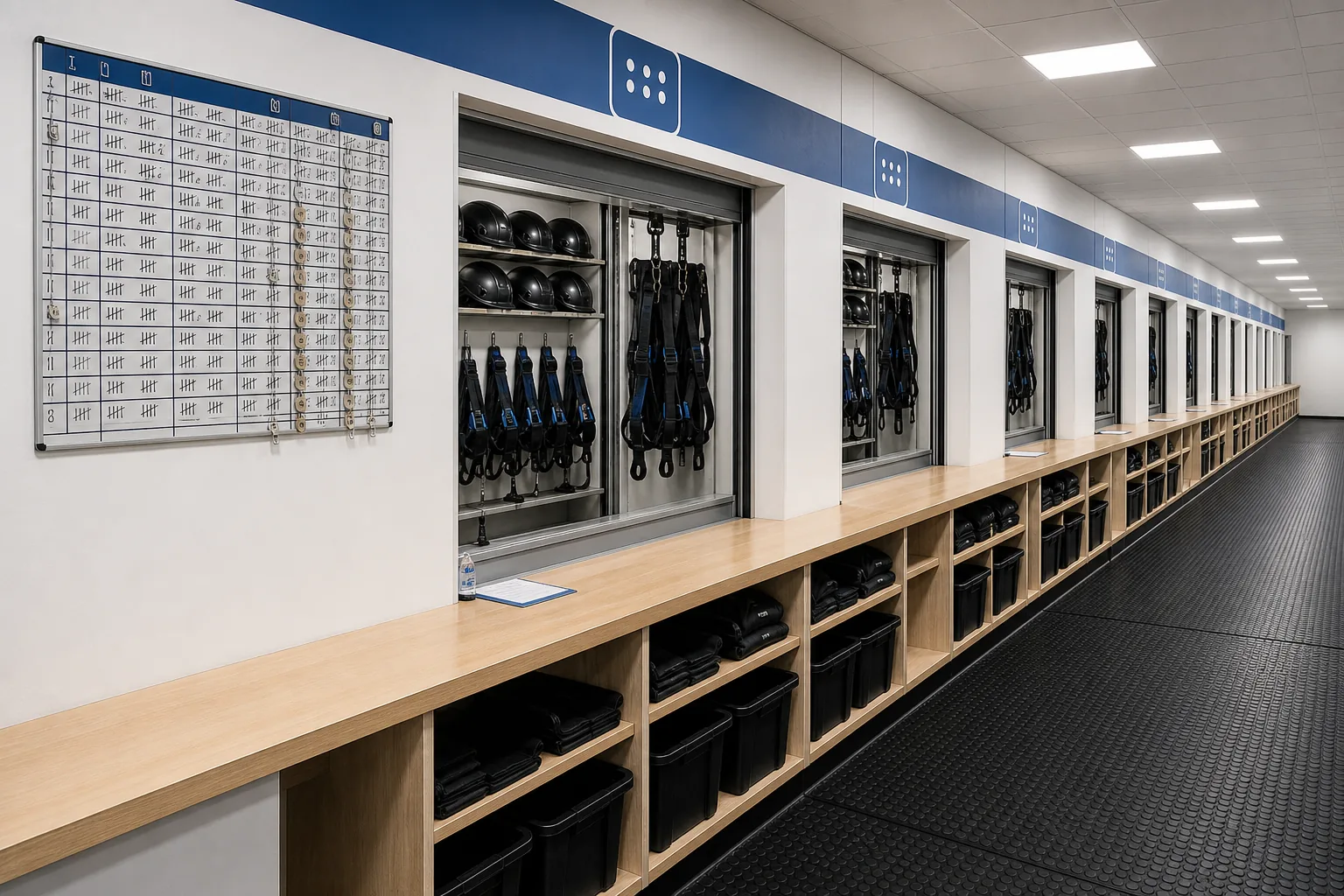
Every tile on your dashboard is green.
Completion rate: green.
Overdue population: green.
Executive summary: green, with a small celebratory tick that appears to have been designed by somebody who has never watched a forklift turn too sharply near a loading bay.
Then a frontline worker meets the one decision point that creates the exposure.
A changed waste stream.
An unfamiliar piece of protective equipment.
A contractor controlling the immediate work area.
A report that needs escalation, rather than the sort of calm nod that lets the quarterly completion figure stay aesthetically pleasing.
The person has completed the module.
That may be important.
It is not the whole question.
Completion is a record of a learning event. Safe practice is a claim about judgment and behaviour in a particular situation.
The first stores cleanly in an LMS.
The second lives inconveniently in the work.
This gets awkward because compliance programmes genuinely need records.
Auditors, regulators, workers, managers, and whoever inherits Compliance_Training_Master_FINAL2.xlsx during a merger all need to know who was assigned what, when, and under which rule.
Your record is not bureaucratic surplus.
It is part of the control.
It is just not evidence of everything you hope it is evidence of.
The course starts with a scope decision, not an enrolment
Take Rina, moving from office-based purchasing into a field-coordinator role that enters areas where hazardous waste is handled.
The requirement arrives because her task and exposure changed.
Not because a campaign calendar found another Thursday.
For hazardous-waste operations, the training paths run to 8, 24 or 40 hours depending on role and exposure.
So “has safety training” is not a status anybody can use safely.
So you have to decide which path applies to Rina’s duties, her work location and her hazard.
Then keep the policy version and the legal basis that made the assignment necessary.
That is an applicability matrix.
A controlled translation from a rule’s trigger to a person-specific requirement.
Less glamorous than an all-company enrolment.
It also answers the question an inspector is most likely to ask.
Why was this worker in this population?
The same problem appears in a completely different programme. California Government Code §12950.1 applies prescribed harassment-prevention training to employers with five or more employees.
New nonsupervisory employees have a six-month deadline.
Seasonal and temporary workers can have an earlier one.
Your global module may be a perfectly sensible internal control.
It is not the same thing as the state-defined population, unless the system records the source and the scope.
One word, mandatory, has now concealed several distinct claims.
Which is how a clean dashboard develops an unusually complicated relationship with reality.
A green badge is not a work gate
You can give Rina calendar time, a device, language support and a course link.
Good.
She may still not be cleared to do the work.
Regulators say plainly that computer-based training alone can be insufficient where a standard requires hands-on experience and questions.
For general-site hazardous-waste work, 24 hours of supervised field experience follow the initial instruction.
So the correct work gate can require theory completion, a practical result, site orientation, and an unexpired prerequisite.
Those are related events.
They are not aliases for each other.
Your operational system has to tell the staffing scheduler and the field-access process that Rina is not yet authorised for the task.
An LMS badge no supervisor can see is not a safety control.
It is a small, attractively coloured fact living alone.
None of which means calling a failed practical demonstration a “noncompliant employee” and moving on.
It means your system should say not yet authorised.
That outcome lets the trainer remediate the actual gap.
And it lets the safety owner ask whether the instruction, the equipment, the procedure or the role assignment failed the worker first.
The certificate cannot preserve that distinction if it overwrites the assessment result.
Four questions, four different answers
Attendance asks whether somebody was present.
An acknowledgement asks whether somebody signed.
A quiz asks whether somebody selected an answer under test conditions.
A skill demonstration asks whether somebody performed a defined action while an assessor watched.
These are not rival religions.
They answer four different questions.
The durable object is Rina’s ability to recognise the relevant condition and take the safe action where the work happens.
The assessment is a proxy, designed to supply some evidence of that ability.
The completion certificate is a record that the proxy was administered.
Every credential and every course has a boundary of that kind.
The useful discipline is knowing which boundary you are standing inside when the scheduler asks a question.
The record is doing real work, which is the difficulty
None of this argues against mandated training, refresher cycles, audit trails or certificates.
A record can show that you identified a required population, delivered a specified version, used a qualified trainer, recorded a result, and gave a worker a route to completion.
It supports retrieval during an inspection.
It can reveal an unassigned transfer, an expired prerequisite, a missing provider record, or the remarkably popular administrative condition known as “nobody remembered to update the roster.”
And the rules are specific about it, too.
For bloodborne pathogens, 29 CFR 1910.1030 requires four training-record elements.
Dates.
Content or a summary.
Trainer names and qualifications.
Attendee names and job titles.
It requires those records to be kept for three years from the training date, and training to occur at least every 12 months.
That is concrete audit evidence.
A programme that cannot retrieve it has a real control problem.
But notice what those fields are for.
They let a reviewer test identity, scope, timing and content.
“Done” cannot do that work by itself.
The shipyard fire-protection rule, 29 CFR 1915.508, is another useful refusal to generalise. Workers already employed when the rule took effect had a 90-day deadline.
New employees get training on initial assignment.
Records carry the employee name, the trainer name, the training type and the dates, and are retained for one year from creation or until replaced, whichever is shorter.
Those are not enterprise defaults.
They are properties of that rule.
Set one universal retention period because it looks disciplined, and you will over-retain some personal data while losing other required evidence.
The archive label does not become correct because it says FINAL_RETENTION_POLICY_APPROVED.
Refresh is a decision about current risk
Refresh cycles matter because work and risk change.
The bloodborne-pathogens rule requires training at least every 12 months.
Hazardous-waste work has an eight-hour annual refresher, and a substantial gap can require repeating the initial training, decided case by case.
That is a reason to keep a due-date engine.
It is not a reason to believe the engine has measured current judgment.
A new waste stream, modified protective equipment, an incident, a near miss, a long absence from the work, or an observed failure can all reopen the case before the nominal cycle expires.
So the review asks you a better question.
Can this worker now perform the expected duties safely, under the changed conditions?
Sometimes the answer is another module.
Sometimes it is a local briefing, supervised practice, a revised procedure, a field observation, or an access restriction while the issue is resolved.
Your completion rate does not know which.
It has no opinion, despite the confidence of the tile.
California’s statute supplies the legal version of the same distinction.
The state can seek an order requiring a covered employer to comply, and completion of the prescribed training does not insulate that employer from harassment liability.
A course record is a preventive-control record.
It is not a release from the consequences of a failed process.
That is not a criticism of whoever owns the programme.
It is an instruction about the burden a record can reasonably carry.
AI turns administrative traces into behavioural claims
For years this ambiguity was managed by specialists who knew that a green completion tile carried an asterisk, even when the board deck did not.
Then workforce systems began combining HR data, learning records, access status, credential fields, incident categories and task histories.
Then a model was asked, very reasonably, which teams were compliant and which workers were risky.
It sees tidy fields.
Assignment date.
Completion date.
Score.
Certificate issue date.
Expiry date.
It can rank, predict, and produce a heat map with enough gradients to start a small weather service.
But an administrative trace is not behavioural evidence because it happens to be machine-readable.
A completion field can support an audit claim: the assigned module was completed on a recorded date.
It cannot, alone, support a claim that the person will recognise an exception, challenge an unsafe instruction, use the required procedure, or report a problem at the moment it matters.
So the data model needs separate objects.
Audit evidence.
Assessment evidence.
Authorisation.
Incident findings.
Beside each result it needs the rule source, the course version, the assignment reason, the assessor and the correction history.
It has to preserve what was changed and why, and a downloadable certificate must never rewrite the authoritative event.
Then an AI system becomes genuinely helpful.
It can find missing assignments, flag expired prerequisites, reconcile a transfer against the applicability matrix, retrieve a bounded audit file, and route a changed-risk case to a person.
Excellent uses of a very patient machine.
What it should not do is convert a completion percentage into an estimate of safe conduct, without the separate evidence that claim requires.
Otherwise the model is not detecting risk.
It is grading the filing cabinet.
Keep the evidence honest
Your practical design is not elaborate.
Store the rule source and its jurisdiction with each requirement.
A requirement in 29 CFR 1910.1030 is not a policy convention, and a California rule is not a global default.
Map the requirement to observable decisions.
Identify the hazard.
Select the protective action.
Escalate the report.
Stop the task.
Apply the relevant handling control.
“Understands compliance” is not observable, which makes it very popular in slide decks and nearly useless at a work gate.
Then use the evidence that matches the consequence of the decision.
Retain the assignment, the content version, the delivery details, the assessment result, the observer sign-off, the clearance status, the expiry and the correction history.
Give access to people with a legitimate compliance role. Do not turn scores or accommodation details into a manager leaderboard.
And investigate incidents and observed failures separately from completion rates.
The investigation can find a knowledge gap.
It can also find confusing equipment, unworkable procedures, insufficient supervision, or a scope rule that put the wrong person into the wrong task.
A green course tile cannot distinguish those causes.
A good programme can.
The completion certificate stays valuable.
It proves that its event happened.
The durable capability is what happens when the rule, the risk or the exception turns up at work.
Two records.
One of them is not a substitute for the other.
What the record establishes
- Distinguish audit evidence from evidence that a person can perform a critical task safely.
- Map each requirement to the role, location, exposure, task, and rule source that make it applicable.
- Use scenario and observed field checks when a controlling requirement calls for practical capability.
- Retain worker, course-version, delivery, assessment, and assignment records according to the applicable requirement.
- Treat changed hazards, incidents, and lapses from work as reasons to review capability separately from completion status.
- Keep compliance dashboards from converting completion fields into unsupported behavioural or risk claims.
Asked in the review
- Does a completed compliance course prove that someone can do the job safely?
- No. A completion record proves that a defined learning event occurred and can identify its date, content version, provider, and participant. Safe work requires evidence that the person can recognise the relevant condition and take the required action in the actual work context. OSHA says online training alone may not satisfy standards that require hands-on experience and an opportunity to ask questions.
- What should a compliance training record contain?
- The record contains the evidence required by the applicable rule and enough context to interpret it: worker identity, assignment source, course and version, delivery date, trainer or provider, result, and practical observation where relevant. Under 29 CFR 1910.1030, bloodborne-pathogens training records include dates, content or a summary, trainer names and qualifications, and attendee names and job titles.
- How does an employer decide who actually needs a required course?
- An employer applies the governing requirement to the worker's role, task, location, exposure, licence status, or other trigger, then records that decision in an applicability matrix. Department membership alone is not a reliable scope rule. In California, Government Code §12950.1 applies prescribed harassment-prevention training to employers with 5 or more employees, while other internal learning may serve a wider audience.
- What happens before someone is cleared for hazardous-waste work?
- The worker receives the training path that matches the work and remains outside the relevant task until its conditions are met. OSHA's HAZWOPER examples include 8-, 24-, and 40-hour courses. General-site workers require 24 hours of supervised field experience after initial instruction. A learning-management completion flag is therefore not the same record as operational authorisation.
- When does a quiz need a practical check as well?
- A practical check is needed when the applicable standard or task requires demonstrated performance rather than recognition alone. OSHA's non-mandatory HAZWOPER Appendix E guidance says a documented proficiency assessment uses a written assessment and skill demonstration; when it pairs a written test with a skill demonstration, the written test has at least 25 questions. The programme records what was observed and who made the judgment.
- How long should compliance training records be kept?
- The retention period follows the applicable requirement, not a universal learning-system setting. Bloodborne-pathogens training records under 29 CFR 1910.1030 are maintained for 3 years from the training date. Shipyard fire-protection records under 29 CFR 1915.508 are retained for 1 year from creation or until replaced by a new record, whichever is shorter. Different records can have different access and preservation rules.
- Does annual refresher training mean the risk is controlled?
- No. A refresher cycle creates a record that a recurring control occurred; it does not settle whether the worker can handle a changed hazard or actual decision point. The bloodborne-pathogens rule requires training at least every 12 months. OSHA also describes an 8-hour HAZWOPER refresher and says a substantial gap can require repeating initial training case by case.
- Can an employer rely on a certificate after an incident?
- A certificate can show that a course or assessment event occurred, but it does not end an investigation. The investigation still examines whether the requirement applied, the instruction was understandable, the work system supported the rule, and the worker could perform the required action. California Government Code §12950.1 says completion of harassment-prevention training does not insulate a covered employer from harassment liability.
- Why is a hands-on certification different from a multiple-choice pass?
- The evidence is different because the assessment method is different. CompTIA Security+ SY0-701 has up to 90 questions in 90 minutes and a 750 out of 900 cut score. Red Hat Certified Engineer EX294 is a 4-hour performance-based examination on a live Red Hat Enterprise Linux system, graded on operational system state. Neither result automatically proves every form of workplace judgment.
- What should an AI compliance dashboard be allowed to say?
- An AI compliance dashboard can report completion, assignment, expiry, missing evidence, and the rule source attached to each record. It should not represent those fields as proof of safe behaviour or as a behavioural risk estimate without separate evidence. A completion percentage measures administrative status. Scenario results, observed performance, incident findings, and work conditions are different evidence objects and remain distinguishable.
- What should happen when a trained worker fails the critical decision point?
- The programme records the failure as evidence about the control system and keeps the worker out of the task where necessary. It then investigates instruction, equipment, local procedure, supervision, role fit, and changed conditions rather than overwriting the result with a completion certificate. Targeted remediation and a new observed check can establish whether the required behaviour is now demonstrated.